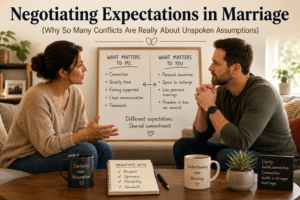
Many Conflicts Are Really About Unspoken Assumptions
Many marital conflicts don’t begin with bad intentions. They begin with unspoken expectations. One partner feels disappointed. The other feels blindsided. Both feel justified. And neither is entirely sure how the gap opened in the first place. When expectations go unnamed or unexamined, they subtly shape how partners interpret one another’s behavior—and how quickly conflict escalates. In fact, learning how to negotiate expectations in marriage is crucial to preventing many of these misunderstandings.
Expectations are inevitable—and often invisible
Every marriage is built on expectations. Some are explicit: If you want to understand how to negotiate expectations in marriage, you must first acknowledge these foundational beliefs.
- Who does what
- How decisions are made
- How money is handled
But many of the most powerful expectations are implicit:
- How often we talk
- How affection is shown
- What support should look like
- How quickly issues should be addressed
Because these expectations often feel “obvious” to the person holding them, they go unspoken—until they’re violated. This makes the need to learn ways to negotiate marital expectations even more important for both partners.
When expectations turn into disappointment
Unmet expectations usually don’t show up as clear requests. They show up as:
- Frustration
- Withdrawal
- Criticism
- Emotional distance
One partner thinks, “You should know this matters to me.” The other thinks, “I didn’t realize I was doing anything wrong.”
Without clarity, partners often assume bad intent by their partner when there is only misunderstood difference. Therefore, taking time to discuss how expectations in marriage can be negotiated properly reduces these moments of confusion and pain significantly.
Why couples struggle to talk about expectations
Negotiating expectations can feel risky because it touches deeper fears: For this reason, understanding how to negotiate the expectations that arise in marriage requires vulnerability.
- Am I asking for too much?
- Will I be seen as needy or demanding?
- What if we want different things?
So instead of naming expectations directly, couples argue about behavior—or worse, they stop bringing things up at all. When you consider how to negotiate expectations with your spouse, these kinds of fears are at the heart of the challenge.
But, unfortunately, expectations don’t disappear when they’re unspoken. They become more rigid.
Expectations are not demands
One of the most important shifts couples can make is learning to distinguish between expectations and demands. It’s often overlooked, but how to thoughtfully negotiate expectations in marriage means first understanding this distinction.
An expectation says: “This matters to me.”
A demand says: “You must meet this—or else.”
Healthy negotiation begins when expectations are treated as information, not ultimatums. This allows couples to explore questions like:
- Where did this expectation come from?
- Is it realistic given our current season of life?
- How important is this compared to other needs?
- What flexibility exists on both sides?
A short example
For years, one partner expected regular emotional check-ins at the end of the day. The other expected evenings to be unstructured and low-demand after work. Neither expectation was wrong. But because neither was named clearly, both partners felt repeatedly disappointed. Once they articulated their expectations—and the needs underneath them—they were able to negotiate a rhythm that honored both connection and decompression. This small example demonstrates how negotiation of expectations in marriage can look in a real situation.
The conflict wasn’t about caring less. It was about assuming too much.
How to negotiate expectations constructively
When approaching expectations, it helps to follow a few simple guidelines if you want to negotiate expectations in marriage effectively:
- Name expectations as preferences, not truths
- “Something that matters to me is…”
- Separate impact from intent
- Disappointment doesn’t mean betrayal.
- Invite dialogue, not compliance
- “How does this land for you?”
- Look for patterns, not perfection
- Sustainable agreements matter more than rigid rules.
Negotiation is not about getting everything you want. It’s about creating shared understanding and workable agreements; that’s really how best to negotiate expectations in your marriage and build long-term trust.
When expectations can’t be met
Sometimes, expectations can’t be fully satisfied—at least not right now. In those moments, couples still have important options: These are the moments that best illustrate how to negotiate the expectations that come up in marriage with both flexibility and compassion.
- Adjust expectations
- Mourn what isn’t possible
- Find partial or alternative forms of support
- Reaffirm commitment despite difference
Learning to negotiate expectations honestly builds trust—even when outcomes are imperfect.
Why this matters for long-term health
Many couples assume that if they truly loved each other, expectations would naturally align. In reality, alignment is built, not assumed. That’s why, for long-term connection, taking the time to learn how to negotiate expectations for your marriage is absolutely essential.
In Six Habits of a Healthy Relationship, I describe expectation negotiation as an essential part of healthy conflict resolution. When couples bring expectations into the open—with curiosity and respect—conflict becomes less personal and far more manageable.
Marriage thrives not when expectations disappear, but when they are handled with clarity, humility, and care.