

Nearly every couple wants the same thing. We want a love that grows deeper with time rather than fading into duty and routine. Yet many couples secretly wonder whether that kind of relationship actually exists. I believe it does. I call it Mature Love.
In an earlier article I introduced what I call the Five Stages of Marital Satisfaction. Although every marriage is unique and not all couples will go through each stage in the same way or to the same degree, I’ve found the stages to be remarkably common. In my book, Six Habits of a Healthy Marriage, I state that the stages are a roadmap to help you know where you are and where you’re headed.
In brief, most marriages progress from Enchantment (euphoria and well-being) to Disillusionment (the loving feelings wear off and we see each other more realistically) to Stability (a functional relationship that lacks excitement and passion) to Friendship (we take responsibility for ourselves and turn towards each other by doing things together) to Mature Love (we nurture and value each other deeply).
Mature Love is the destination. The question is: how we get there? Let’s look at how you can cultivate Mature Love in your relationship.
Beyond Feelings
Most people think of love as a feeling—a surge of affection, warmth, and desire for closeness. That’s partly true. But the kind of love that lasts for years, that grows deeper rather than weaker, is more than a feeling. It’s a way of being.
So imagine love not just as an emotion, but as a partnership between two whole individuals who freely choose to build a life together. That kind of love doesn’t disappear when stress hits or differences show up. It’s built from something stronger.
In fact, mature love lies at the intersection of three powerful inner capacities: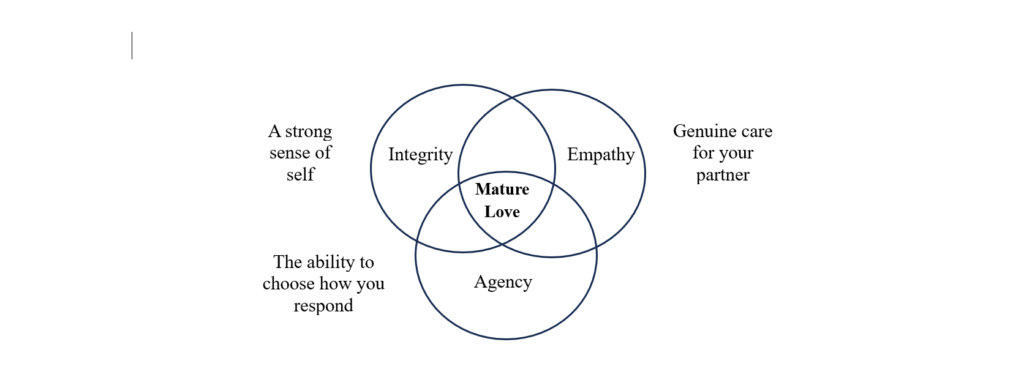 A relationship rooted in Mature Love is one in which two capable, emotionally responsible adults bring their best selves to the relationship. They don’t collapse into each other or abandon themselves but rather grow individually and support one another’s growth. They are open, honest, respectful, and responsive. When these qualities work together, love becomes something stable, equal, generous, and deeply connected. It’s not a fairy tale. It’s real. It’s earned. And it’s richer than the early highs of Enchantment.
Let’s take a closer look at the three principles that shape this kind of love.
Integrity: Bringing a Whole Self to the Relationship
Integrity in marriage is not about moral perfection. It’s about having a clear, grounded sense of who you are. It means you know what you think, feel, value, and need. You don’t rely on others—your spouse included—to tell you who to be or how to feel.
When you’re living from integrity:
- You don’t look to your partner (or others) to validate your worth.
- You can share your truth without attacking or defending.
- You remain true to yourself instead of sacrificing your identity to keep the peace.
- You don’t pretend or hide to avoid conflict.
Integrity allows you to show up in the relationship authentically. You can be known. You can be seen. You can set boundaries without abandoning or punishing your partner. You can communicate difficult truths with respect. Without integrity, relationships become imbalanced—either one person dominates, or both keep parts of themselves hidden. With integrity, both people bring their full humanity to the marriage.
Empathy: Caring About Your Partner’s Experience
Empathy means you care about your partner’s inner world as much as your own. You listen to understand. You make space for their emotions, needs, and perspective. You don’t require perfection from them in order to feel safe or loved.
In a marriage rooted in empathy:
- You want what’s good for your partner, not just what benefits you.
- You want to know them and support them in communicating their truth.
- You recognize them as someone who struggles, hopes, and hurts just like you.
- You communicate as equals, not competitors or parents/children.
Empathy doesn’t mean losing yourself to please your partner. It simply means you love them with respect and curiosity. You see their humanity rather than defining them by their flaws. You forgive more easily. You ask, “Help me understand,” rather than “What’s wrong with you?”
Interestingly, in my work with couples, I’ve noticed that most people lean more naturally toward either integrity or empathy. Some protect their individuality but struggle to make space for their partner. Others care for their partner but silence themselves. Neither extreme leads to Mature Love. To balance the two, we need the third principle: agency.
Agency: Choosing How You Show Up
Agency is your ability to choose your responses rather than reacting on autopilot. It means you own your part in what happens. You take responsibility for your feelings, your needs, and how you express them. You stop making your partner responsible for behaviors that are actually your choices.
Agency allows you to say:
- “I feel upset, and I can choose how to respond.”
- “I’m disappointed, but I don’t need to attack or withdraw.”
- “I want closeness, so I’ll initiate instead of waiting to be rescued.”
- “I can create boundaries without punishment or anger.”
With agency, you learn to regulate yourself—especially during conflict—so you can stay connected even while expressing difficult emotions. Agency is what keeps integrity and empathy from becoming self-centered or self-sacrificing.
Together, these three capacities make Mature Love possible. Let me share an example of a couple who demonstrated these three capacities. Hopefully, you’ll see some application in your marriage.
Bringing It All Together: Meet Mark and Lena
It was getting late and Mark found himself aimlessly scrolling through his phone, a tense knot forming in his stomach. His wife, Lena, had just called to say she’d be late for dinner—again. Lately, her career as a graphic designer had taken off, and the long hours were becoming a familiar and increasingly frustrating routine. Mark valued their quality time together and felt disappointed whenever Lena had to work late. Recently, on nights like this, he’d begun simply getting his own meal and leaving Lena to fend for herself. But this time, he chose a different response.
He took a deep breath and reminded himself that his feelings were his own; they were not caused by Lena. He chose to respond with wisdom rather than blame. He went into the kitchen and started preparing dinner, putting on some music that reminded him of their early, carefree days.
When Lena arrived, weary and apologetic, she found Mark calmly stirring a pot. She steeled herself for the inevitable argument, but instead, Mark offered her a glass of water. “Long day?” he asked gently.
Lena was surprised. “Yeah,” she sighed, sinking into a chair. “The client kept changing their mind. I’m so sorry I’m late.”
Now, Mark leaned into empathy. Rather than launching into his rehearsed complaint, he saw her, not as the source of his frustration, but as a person he loved who was exhausted and stressed. He listened without interruption as she explained the details of her day, putting his own feelings aside for a moment to truly understand her perspective.
After she finished, Mark spoke from a place of integrity, but with empathy. “I hear how much pressure you’re under right now,” he said. “I’m really proud of how hard you’re working. And for me, our time together is really important—I miss you. It’s starting to feel like we’re just roommates sometimes.” He wasn’t blaming her but, rather, was stating his own truth.
Lena’s shoulders dropped, not in defeat but in relief. He wasn’t attacking her; he was being vulnerable and authentic. “I miss you too,” she admitted. “And I can understand why not knowing when I’ll be home leaves you feeling unimportant. I don’t want my work to keep crowding out our relationship.”
They paused, now both looking for a way forward. This is where their combined agency came in. Instead of it being Mark’s way or Lena’s way, they worked together as a team. They decided to set a new boundary: on her late nights, she would text him a quick update so he wasn’t left wondering. In return, Mark would understand that these busy seasons came with the territory and would use his solo time for a personal project he had been putting off. They agreed to protect their weekends fiercely.
The conflict wasn’t immediately erased, but it was transformed by their collaborative effort. By using his agency to choose a different response, Mark made space for empathy and yet remained true to his inner feelings by expressing his disappointment and concern for their relationship. Lena, in turn, felt seen and supported rather than attacked. The result was a deeper connection, a more Mature Love forged in honest communication and mutual respect.
A final thought
One of the greatest myths about marriage is that lasting love simply happens if you marry the right person. In reality, Mature Love is something we build. We don’t build it through grand romantic gestures, but through hundreds of ordinary choices. Each time you choose integrity instead of pretending, you strengthen your marriage. Each time you choose empathy instead of judgment, you deepen connection. Each time you choose agency instead of blame, you strengthen the foundation of your marriage.
Over time, those choices create something remarkable: a relationship where both of you feel known, respected, supported, and deeply loved. That’s Mature Love. And it’s within reach of every couple willing to grow.
Questions to Consider
As you think about your own relationship, which of these three capacities of Mature Love comes most naturally to you? Integrity? Empathy? Agency? Which one would strengthen your marriage most if you intentionally practiced it this week?
Growth begins when we stop asking how to change our partner and start asking how we can bring our best self to the relationship.


Thank you for this! I love reading you. If only we could all put into practice what you teach, many relationships would not end like they often do. You say that there is no right person but that mature love is built through hundreds of ordinary choices. But what happens if only one person in the relationship understand this and works hard on building mature love while the other one doesn’t and remains rigid on his way of thinking and doing, can it still work? Can something still be done? At a certain point I gave up. I learned a lot, made many mistakes for sure, but kept trying real hard until I was too hurt to continue further. Can one person alone build Mature Love?
Hi Noemi,
You are welcome, and thanks for your good question. It is hard when only one person is open to working on the relationship. I’m hearing that you have taken ownership and improved yourself–the way you’re communicating and participating in your marriage–and yet your spouse is not changing or reciprocating. I’m sorry you have been hurt and not ready to keep trying.
To answer your question directly, one person cannot build mature love on their own. It takes two of you and you can’t make his choices for him. So it is appropriate for you to consider all your options, including ending the relationship. Of course, that is not easy and brings it’s own set of consequences.
Sometimes it’s helpful to talk to a professional to not only gain insight and skills but also have support in moving forward.
My hope is that you can continue finding ways to honor yourself whether you stay in the relationship or decide to leave. This is not easy. My best to you.
Roger