
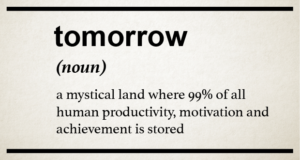
1. Be friendly to your future self
Your future self has to get up tomorrow morning and do the dishes (on top of everything else). This self will be grateful if you do them tonight. Your future self may be burdened every day by a cluttered house and would thank you if you would leave a more orderly environment. Your future self will be grateful and relieved that you paid all your bills on time so you don’t have any late charges or nagging worries. Your future self will appreciate the energy and fitness that come from getting to the gym in a timely way. So the first tip is to think deeply about your future self. Develop compassion for this self and make a decision to honor this person. Life will get easier as you do so.
2. Start small-focus on the next step
We sometimes procrastinate because the task seems so big, so overwhelming. Cleaning the house may seem like a huge undertaking. Writing a book (or even report) may seem daunting. Getting those six-pack abs seems almost impossible. So don’t look at the whole task. In fact, so many tasks can’t be done all at once. Chunk it. Break it down into small steps and focus on the first little step. Then take action on the next step. Then let that step lead to the next step. Pretty soon you have some momentum. (A body in motion tends to stay in motion.) This momentum will help propel you forward.
3. Use a timer to get into action
This is similar to number two. If a task seems daunting and unpleasant then set a timer for how long you’ll do it—maybe five minutes, maybe ten, or even twenty. Do it for that long and then step away. Take a break. If you decide to continue fine, but not necessary. Getting into action if only for a few minutes will give you a sense of control and accomplishment. You can then schedule another few minutes for a later time.
4. Eliminate distractions and set boundaries
There are many distractions to keep you from completing a task. It is so easy to answer a phone call, look at your inbox, see what’s streaming, check the weather, talk to a friend or co-worker. Turning off distractions means creating a strong boundary so that nothing can intrude—turning the ringer off your phone, logging off email, closing a door, etc.) It means blocking your time to give 100% focus to the task at hand.
5. Learn to be fully present (even when unpleasant)
We resist unpleasant tasks. We resist not only by putting them off but by distracting ourselves to avoid our feelings as we do them. Being present means being fully engaged in the task, mentally as well as physically. Embrace it, even if unpleasant. Be in the moment. Be present to what it is like in your mind and body as you do this task. Notice how being fully present to what seems to be unpleasant (doing dishes, working out) transforms the unpleasant into tolerable if not downright enjoyable. And if it doesn’t, that is okay too. Unpleasantness is part of life.
6. Build structures that make action easier
A structure is any system, routine, or mechanism which supports desired behaviors. Setting out a gym bag the night before you work out is a structure. Inviting a group of friends over for an evening is a structure to help you clean your house. Making a list of all the benefits of getting started on that book you’ve meant to write and posting it on your bathroom mirror is a structure. Asking a friend to hold you accountable for doing a task or accomplishing a goal is a structure. In short, it is anything that not only reminds you but makes it easier to get started on a task or goal.
7. Rethink your to do list
Is your to do list aligned with what you really want? Take a deeper look at why you are procrastinating and perhaps you’ll discover something about yourself. Maybe some/many items on your list are “have-tos” and “shoulds” which will wear you down and drain you of enthusiasm and emotional energy. Can you eliminate some of them? Are there things in life that you need to say “no” to so you can feel more in the driver’s seat of your life and create more space for joy?
I know that there are lots of things we have to do to make a living and manage life, things we’d not choose to do if we were retired and/or wealthy. Can you turn these “shoulds” into wants by thinking more deeply about why you do them and the rewards you’ll get from doing them? Everything in life has a cost, a price tag. Perhaps you can focus less on the cost and more on the value and benefits. Seeing, feeling the rewards is a great motivator.
8. Reward progress to build momentum
The reward doesn’t have to be big. It could be taking a break, stepping outside for a short walk, having a piece of chocolate, talking to a friend or co-worker, doing a puzzle, etc. Something you enjoy and which will motivate you to press forward. Of course, you can celebrate big accomplishments with a bigger reward—a vacation, night with friends, or purchase of some item that you’ve been coveting. Use the reward as a way of savoring and celebrating your accomplishment.
Don’t be overzealous as you apply these tips. It is okay to start small. Pick one area in which you’ve been procrastinating and focus here first. Give yourself a success and then move on to another area as you gradually build discipline to take on bigger tasks and goals.
And remember that these tips are not magic. Some work for some and not for others, so consider which appeal to you. Which two or three could be most helpful in overcoming your tendency to procrastinate? Or do you have other ideas? What have you found that works? (Share it below.)
Ultimately, you have to want an alternative outcome more than the status quo in order to find the motivation to act when it would be easy to procrastinate. So think deeply about what you want and why and let this become the most important driver of your behavior.
(By the way, if you like this post, share it by clicking on the social media buttons on the right.)

I really like the idea of looking at your future self. This helps me realize I am actually doing something for myself that will bring me benefits worth the sacrifice now.
Exactly, Rolayne. It is certainly much easier to do something when we see the future benefits.
Dear Dr. Allen,
Isn’t turning “shoulds” into “wants” part of beginning The Journey From Fear To Love?”
Yes, David. It is certainly one important aspect of the journey.