We tend to think of personal growth in terms of large decisions: Choosing a career. Beginning or ending a relationship. Moving to a new place. Making a commitment. Setting an ambitious goal.
These decisions matter. But much of who we become is shaped in smaller moments that rarely feel important at the time. Your spouse says something critical, and you decide whether to strike back or remain curious. A coworker receives recognition you wanted, and you choose between resentment and generosity. Your teenager makes another mistake, and you respond with anger or use the moment to teach. You make a commitment and later discover that keeping it will be inconvenient.
No one else may recognize these moments as consequential. Yet each one invites you to make a choice. Over time, those choices become patterns, and those patterns shape our character, relationships, and lives.
Many of life’s most consequential choices occur in our conversations. In my new book, The Art of Dialogue, I explore how the choices we make during disagreement can move us toward understanding and connection—or toward greater distance. But such choices extend far beyond difficult conversations. They arise wherever life calls on us to practice choosing how we will respond.
I call these key moments.
What Makes a Moment “Key”?
A key moment is any moment that calls for a response and invites us to practice choosing how to respond intentionally. Some key moments are obviously significant: a painful conflict, a moral dilemma, a serious disappointment, or an important decision. Others appear ordinary. You are tired, and someone needs your attention. You realize that you have made a mistake. A conversation becomes uncomfortable. You feel the urge to avoid something difficult. You have an opportunity to offer encouragement, tell the truth, keep a promise, or admit that you were wrong.
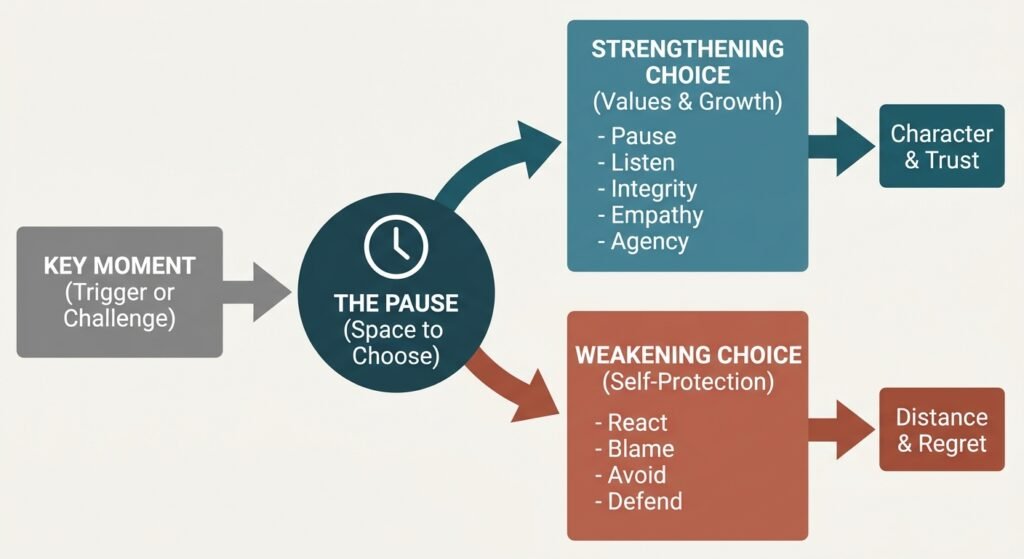
What makes the moment important is not its size. It is the choice embedded within it. In a key moment, we can react from habit and self-protection, or we can pause and respond in a way that reflects the person we want to become.
We Are Always Becoming
We sometimes talk about character as though it were a fixed possession. A person has integrity, patience, courage, or compassion. But these qualities are also practices.
We become honest by telling the truth when dishonesty would be easier. We become courageous by acting when we feel afraid. We become patient by managing our impatience. We become compassionate by making room for another person’s experience. The opposite is also true. Each time we avoid responsibility, blame someone else, break a commitment, or silence a truth that needs to be spoken, we reinforce a pattern. What begins as a single reaction can gradually become a familiar way of being.
One moment does not define us. We all become defensive, lose patience, make poor choices, and fall short of our values. But repeated choices create direction. We are not only deciding what to do. We are practicing who to become.
Our First Reaction Is Not Our Final Choice: Choosing How to Respond
During a key moment, our first reaction is often automatic. We feel criticized and become defensive. We feel afraid and want to withdraw. We feel disappointed and look for someone to blame. We feel hurt and want the other person to hurt as well. These reactions are part of being human. Emotional maturity does not require us to prevent them from occurring. It asks us to become aware of them. Between the initial reaction and what we do next is a moment of choice. Sometimes that space is generous and obvious. At other times, it lasts only a few seconds.
Yet even a small pause can allow us to ask: What is happening inside me? What am I about to do? Is this response consistent with who I want to be?
We may not choose our first thought, feeling, or impulse. But with awareness and practice, we can take responsibility for what follows.
Weakening and Strengthening Choices
In key moments, we make choices that either weaken or strengthen ourselves and our relationships. Weakening choices are often driven by self-protection. We attack, blame, withdraw, manipulate, excuse, or avoid. These reactions may bring temporary relief or give us a sense of control, but they usually carry a longer-term price.
A sharp response releases our anger but damages trust. Avoiding a conversation reduces our anxiety but allows resentment to grow. Blaming someone else protects us from shame but keeps us from learning. Breaking a commitment makes the moment easier but weakens our integrity.
Strengthening choices do not always feel better in the moment. They may require us to tolerate discomfort, uncertainty, or vulnerability. We pause before reacting. We tell the truth. We listen. We acknowledge our contribution. We keep a commitment. We establish a boundary. We apologize and repair. A strengthening choice is not necessarily the easiest or most pleasant response. It is the response most aligned with our values and the kind of person we want to become.
The Choice Is Often Between Protection and Growth
Many difficult behaviors begin as attempts to protect ourselves. Defensiveness protects us from feeling inadequate. Blame protects us from shame. Control protects us from uncertainty. Withdrawal protects us from conflict or rejection. Avoidance protects us from discomfort. These protective reactions make sense. They may even have served us at another time in our lives. But a strategy that once helped us survive may later limit our ability to grow, love, and connect.
The important question is not, Why am I reacting this way? That understanding matters, but it is only the beginning. The deeper question is, Is this reaction helping me become the person I want to be?
Self-protection is not always wrong. We sometimes need distance, limits, or safety. But when protection becomes our automatic response to every uncomfortable moment, our lives grow smaller. We become less open, less flexible, and less able to engage honestly with ourselves and others. Growth asks us to remain present long enough to choose.
Integrity, Empathy, and Agency
Three qualities are especially important in life’s key moments: integrity, empathy, and agency.
Integrity asks: What is true, and what response is consistent with my values? Integrity may require us to admit a mistake, keep a promise, speak honestly, or stop pretending that something is acceptable when it is not.
Empathy asks: What might this moment be like for the other person? Empathy does not require agreement. It asks us to make room for an experience beyond our own and to recognize how our behavior affects others.
Agency asks: What choice is mine to make? Agency reminds us that we cannot control another person’s behavior, guarantee an outcome, or rewrite the past. But we can choose our next step.
Together, these qualities help us move beyond reaction. Integrity grounds us in what matters. Empathy expands our perspective. Agency returns us to our power to choose.
Key Moments Shape Relationships
Relationships are not built only through major declarations of love or occasional acts of sacrifice. They are shaped through countless ordinary exchanges. Do I look up when you begin speaking? Do I become curious when we disagree? Can I remain respectful when I am frustrated? Do I notice when you need comfort? Will I raise a concern honestly rather than allowing resentment to grow? Can I repair the harm I caused? Each response sends a message about whether the relationship is safe, whether the other person matters, and whether difficulties can be addressed.
Trust grows in the same way it erodes: one experience at a time. A single interaction may seem insignificant. But repeated moments of attentiveness, honesty, and repair create a relationship in which people can feel secure and known. Repeated moments of dismissal, criticism, or avoidance create distance even when neither person intended it. Love becomes visible in how we respond.
The Quiet Power of Repair
We will not make a strengthening choice in every key moment. Emotional maturity does not mean responding perfectly. What matters is what we do after we recognize that we have fallen short.
Repair creates another key moment. We can defend what we did, minimize the impact, or wait for the other person to move on. Or we can return and say: “I became defensive and stopped listening. I’d like to try again.” “My tone was disrespectful. You did not deserve to be spoken to that way.” “I avoided the conversation because I was afraid of how it would go. I’m ready to talk now.”
Repair does not erase what happened. It demonstrates that the mistake does not have to become the final word. It turns failure into an opportunity for responsibility, learning, and renewed connection. Sometimes who we are becoming is revealed less by whether we make a mistake than by the choices we make following our recognition of the mistake.
Small Choices Create Direction
Personal transformation is often less dramatic than we imagine. We may wait for a breakthrough—a moment of insight, inspiration, or determination that changes everything. Such experiences can be powerful, but lasting change usually requires something quieter. We notice the pattern. We pause in the moment. We make a different choice. Then we practice that choice again.
The individual decision may feel small. But each strengthening choice points us in a direction. Over time, we become more capable of responding with courage, honesty, patience, and love because those qualities have been practiced. The question is not whether every choice produces immediate transformation. It is whether our choices are moving us toward or away from the life we want.
Bringing Intention to Your Key Moments
You cannot anticipate every challenge, but you can become more intentional about the moments that repeatedly test you. Consider:
- What situations most often trigger a reaction you later regret?
- What do you tend to protect when you feel threatened?
- What weakening choice do you make most predictably?
- What strengthening response would better reflect your values?
- What reminder could help you recognize the moment before reacting?
Choose one recurring situation and decide in advance how you want to respond. You might decide: When I feel criticized, I will take one breath before defending myself. If I make a mistake, I will acknowledge it without offering an immediate excuse. In a moment when I feel disconnected, I will express what I need rather than withdrawing. As I am tempted to avoid a conversation, I will identify one honest and respectful way to begin.
You will not always remember. You will not always follow through. But intention increases the likelihood that you will recognize the choice hidden inside the moment.
Who Are You Becoming?
At the end of a day, we may evaluate ourselves by what we accomplished, what went well, or what remains unfinished. However, there is another question worth asking: Who was I becoming in the moments I lived today? When I felt threatened, did I become more defensive or more open? When someone needed me, did I become more attentive or more preoccupied? When I fell short, did I become more accountable or more committed to protecting my image? When I faced discomfort, did I move toward what mattered or away from it?
These questions are not invitations to harsh self-judgment. They are invitations to awareness. Every day gives us new key moments. Every relationship gives us opportunities to practice. Every mistake offers the possibility of repair.
We do not become emotionally mature all at once. We become more mature as we learn to recognize life’s key moments and make choices that strengthen our character, our relationships, and our capacity to live joyfully and love fully. The next key moment may appear ordinary. But the choice within it is helping shape who you are becoming.