

A hallmark of Mature Love is the ability of two partners to share their deeper thoughts, feelings, and needs—and to make room for their partner to do the same. And yet, it is remarkably easy to fall into a negative pattern of interacting by arguing, defending, controlling, accommodating, or avoiding. These styles can feel protective in the moment, but over time they undermine trust, closeness, and emotional maturity.
I want to introduce a structured communication skill that helps bridge the gap between good intentions and real change. It is a process often used by marriage and family therapists to help couples express complaints without blame and transform frustration into constructive requests. It is called the Feedback Wheel.
The Wheel is used when emotions are strong and the risk of escalation is high. It gives shape to vulnerability, helping you stay grounded, clear, and collaborative when it would be easier to attack, withdraw, or shut down.
Why Complaints So Often Go Wrong
Most marital complaints begin with something legitimate. One partner feels hurt, ignored, disrespected, or disconnected. There is a real need underneath the frustration. But the way complaints are expressed often makes repair nearly impossible.
Consider this interaction:
Barb (sighs loudly): “I can’t believe you’re just sitting there scrolling your phone again. It’s like you live in a different world.”
Thomas: “What do you mean? I’m just checking the news.”
Barb: “That’s exactly what I mean. You’re always ‘just checking the news.’ You’re never present.”
Thomas: “I’m right here. We’re in the same room.”
Barb (sarcastic): “Oh, great. Physically present. Emotionally absent. Story of my life.”
Thomas: “Come on, Barb. You’re exaggerating.”
Barb: “You always have an excuse. You’ve become so lazy about this marriage.”
After exchanges like this, couples rarely feel closer. More often, they withdraw, brood, or seek validation elsewhere. Barb vents to her friends; Thomas complains to coworkers about how impossible it is to please his wife. Both leave the interaction feeling misunderstood and resentful.
What’s tragic is that Barb’s underlying need—for emotional presence and connection—is completely legitimate. But the way she expresses it leaves Thomas feeling attacked and hopeless, rather than motivated to respond.
From Complaining to Requesting
The Feedback Wheel offers an alternative. It helps you move from complaining about the past to requesting change in the future.
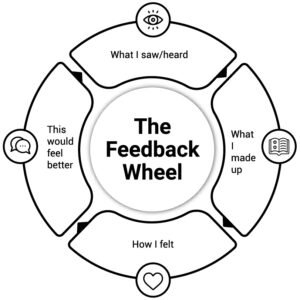
At its heart, the Wheel helps you slow down and separate four different elements that often get tangled together in conflict:
Step One: “What I saw or heard…” These are just the facts. This is what a video camera would show. You’re stating what happened without interpretation. It is specific and observable behavior.
Step Two: “What I made up about it…” This is how you interpreted the event. It is important to recognize that you told yourself a story about what happened and it’s best to let the other person know what you made up rather than making them guess what you thought, felt, or intended.
Step Three: “How I felt about it…” You state your emotions. These are single word statements like anger, hurt, sadness, disappointment. If your first emotion is anger, it’s helpful to get below the surface and figure out what is deeper like fear or some kind of emotional pain.
Step Four: “This is what would help me feel better…” Let the other person know what you would like them to do next time or how to keep the same thing from happening again.
When these elements are blended together—especially under stress—they come out as blame. When they are separated and expressed clearly, they invite understanding and collaboration.
How the Feedback Wheel Works
Let’s return to Barb and Thomas and see how the same issue might sound when Barb uses the Feedback Wheel.
Barb (takes a breath): “Thomas, can I share something that’s been bothering me?”
Thomas: “Okay.”
Barb: “This morning, after breakfast, you sat down and started scrolling on your phone.”
Barb continues: “The story I told myself was that you weren’t interested in connecting with me or starting the day together.” She pauses: “I felt invisible and unimportant.”
Thomas puts his phone down. “I didn’t realize it felt that way to you.”
Barb: “I know you probably just wanted to relax and catch up on the news. What would really help me is if we could spend five or ten minutes together in the morning—maybe having coffee or talking—before we both drift into our screens.”
Thomas: “I can do that. I didn’t know it mattered that much.”
Barb: “It does. Thank you.”
Notice what changes. Barb does not accuse Thomas of being lazy or uncaring. She describes what happened, owns her interpretation, reveals her vulnerable feelings, and makes a clear, doable request. Thomas does not feel attacked—and because of that, he can respond generously.
Why the Wheel Is Hard—and Why It Works
Although the steps of the Feedback Wheel are simple, using them is not always easy. That’s because the Wheel presses against some deeply ingrained beliefs and roles. Many men have been socialized to avoid vulnerability and dependence. Naming softer emotions or making requests can feel exposing or unmasculine. Many women have been taught to prioritize harmony and self-sacrifice, making assertive requests feel selfish or guilt-inducing. In different ways, the Feedback Wheel asks both partners to grow.
But the benefits are substantial. The Wheel:
- Helps you express yourself clearly without blame
- Gives your partner insight into the impact of their behavior
- Reduces defensiveness by focusing on specifics rather than global criticism
- Provides a concrete path for repair and change
- Strengthens collaboration instead of power struggles
No doubt, using the Feedback Wheel is risky because it requires clarity, vulnerability, and the willingness to ask for something concrete. Your partner may not respond as you hope. But the alternative—harboring resentment, complaining indirectly, or withdrawing emotionally—is the greater risk. Nothing changes, and distance grows. The question is not whether being vulnerable is risky. The question is which risk you are willing to live with.
Guidelines for Using the Feedback Wheel
A few simple guidelines will help you use the Feedback Wheel more effectively.
- Let your spouse know that you would like to talk. Find a time that works for them. You want to make sure they are ready to listen. This communicates respect and increases the likelihood that your message will be heard.
- Remember that your motivation is love. Your goal is to improve the relationship—not control, punishment, or getting your way.
- Take responsibility for yourself. The Feedback Wheel works when you own your feelings, needs, and thoughts rather than expecting your partner to change so you can feel okay.
- Let go of the outcome. You may not always get the response you want, and that’s part of being in a relationship with another autonomous person. What matters most is practicing a more honest, respectful, and collaborative way of communicating.
Guidelines for the Listener
- Appreciate your partner’s intent. By using the Feedback Wheel, your partner is choosing clarity and solution over complaining. See this as a gift to the relationship.
- Just listen. You don’t need to defend, explain, or rebut. Your goal is to understand your partner’s experience as they experience it.
- Let your partner know what you hear. Communicate back what you’re hearing so your partner knows you are really listening to understand.
- Let your partner know what you can do. Most of the time you’ll be able to do what your partner requests. If needed, negotiate or modify the request—but avoid leading with what you won’t do. Support your partner’s honesty by helping them succeed.
Personal Application
Notice whether you’re holding onto unspoken frustrations or negative feelings. Are you willing to use the Feedback Wheel to turn those complaints into constructive requests? Start small. Write out one example using the four steps, then look for opportunities to practice. Like any skill, it becomes easier with use.
Using the Feedback Wheel takes humility, courage, and self-responsibility. It’s not about avoiding hard topics—it’s about addressing them in ways that foster trust, intimacy, and growth. As you practice, you’ll release the negative emotions that block connection and move closer to Mature Love. And remember that growth doesn’t come from getting it perfect. It comes from practicing a better way.
Learn more skills for creating healthy relationships in my book: Six Habits of a Healthy Marriage: How to Build Trust, Deep Connection, and Lasting Love.


Greetings Roger,
I love your passion for building better relationships, especially in a marriage. I’m going to share this with my family.
Best Regards,
Bob Shannon
I love this, thank you for offering this very helpful advice!
Is this in your book?
I would like to purchase your new book if it’s available?
Hi DeAnne. I’m glad you loved the article. Yes, this is my book. You can purchase it on Amazon. Here’s a link: https://www.amazon.com/Six-Habits-Healthy-Marriage-Connection-ebook/dp/B0GY9ZJK74/ref=sr_1_1?